As an Amazon Associate I earn from qualifying purchases. This article contains affiliate links that may earn a commission at no extra cost to you.
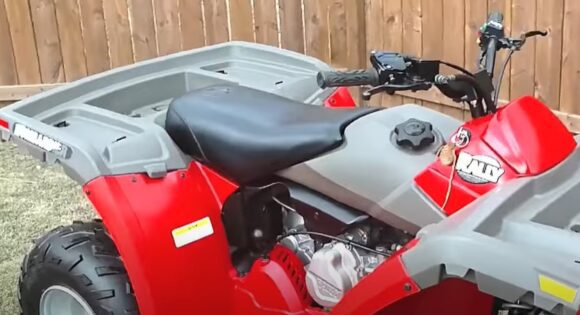
The Bombardier Rally 200 is the small, entry-level quad BRP built as the friendly face of its pre-Can-Am lineup. It is a compact machine, lighter than most utility quads of its day, and a lot of families bought one as a first ATV or for a smaller rider. What sits under the plastic is a 176 cc liquid-cooled Rotax single with a four-valve head and a continuously variable transmission, which makes it easy to ride and pleasant to putter around on.
It is not fast, and if you have seen a figure like 68 mph tossed around, you should read this before you believe it. This article covers the verified spec sheet, the top speed owners actually measure, and the brake and carb quirks plus the loose rear axle nuts that show up on aging examples. It ends with what to inspect before you buy one used.
Rally 200 Top Speed: What Owners Actually Report
Bombardier never published an official top speed for the Rally 200, which is normal for a runabout of this size. The spec sheets list torque, weight, fuel, and dimensions, but not a speed claim. So any exact figure you see quoted is an owner measurement rather than a factory number, and the honest range from the forums is about 45 to 50 mph.
The owner who commuted daily on paved roads put it plainly: his Rally touched about 75 km/h, which is roughly 45 mph, on downhills, and he wanted a bigger front sprocket to gain a little more because he used it as a work commuter on a road with a 50 mph limit.
A second owner in the BRP Rally 200 owner thread came back later to say that once he dialed out the factory throttle limiter, his Rally went around 50 mph. So a stock, limiter-adjusted machine sits right around 45 to 50 mph on flat ground.
That is a long way from the 68 mph that some listings and old ads throw around. A 176 cc single turning a CVT through a solid axle simply does not have the gearing to push a quad-shaped body past about 50 mph, and no owner thread I pulled up reports anything close to 68. Treat that 68 figure as an enthusiast dream, not a spec.
The throttle limiter matters here, because it is the screw and jam nut on the throttle that caps how far the throttle can open. If you buy one used and it feels slow, check that screw before you order sprockets. On some units it is still set for a young rider.
The Engine: A 176 cc Liquid-Cooled Rotax Single, Not Something Bigger
The official Rally 200 spec sheet from BRP lists a 176 cc, four-stroke, single-cylinder, liquid-cooled, four-valve SOHC engine with a 62 by 58 mm bore and stroke. It makes 14.5 Nm of torque at 6,500 rpm, is fed by a Mikuni VM24 carburetor, and starts electrically.
Note that it is 176 cc and liquid-cooled, not the air-cooled wording some sellers use. The 200 in the name refers to the model, not the true displacement. The raw dimension table some used-listing sites copy lists a 5.6 inch ground clearance and 409 lb dry weight, but the factory sheet shows 9.0 inches of clearance and 395 lb, so trust the BRP number.
It is a Rotax-linked single in the same family BRP used in its entry machines of that era, and it is a real engine with an overhead cam and four valves in a small head. Owners describe the power as peppy for the size, and the most common praise is the liquid cooling. One owner who came from a Bayou 220 explained that his air-cooled Kawasaki would lose power on hot summer days, while the liquid-cooled Rally simply kept pulling.
While we are on engines, clear one thing up: the Rally 200 never shipped with the big Rotax aircraft flat-four that circulates in old online spec lists about vintage Bombardier quads. That 912S is a 1,211 cc engine built for light-sport planes, and no Bombardier ATV ever used it. This little quad runs a 176 cc ATV single, full stop.
CVT and a Chain-Driven Solid Axle
BRP fitted the Rally 200 with a continuously variable transmission and a sub-transmission that offers forward, neutral, then reverse positions. It is a belt-driven CVT, so there is no clutch lever and no manual shifting, which is exactly what a newer rider wants. Power goes to the rear through a chain on the right side and a solid rear axle.
There is no rear differential to select and no front drive at all; the Rally 200 is a two-wheel-drive machine with a locked rear end.
Unlike the bigger Bombardier Traxter, which used a push-button hydraulic gearbox, the Rally 200 is a true CVT. Owners like the automatic nature of it and say it pulls forward and in reverse smoothly enough that inexperienced riders feel safe right away. The reverse is useful for parking and backing out of a garage, which suits the machine’s role.
Also unlike the Traxter, and unusual for Bombardier of that era, the Rally is chain driven rather than shaft driven. That is a mixed blessing. A chain needs lubrication and occasional tensioning, but it is cheap and easy to service, and a worn chain and sprockets are simple to swap. Owners mention the chain as one more thing to check on a higher-mile machine.
In practice the CVT makes the Rally about as foolproof as an ATV gets. There is no clutch to slip and no gear to miss, so a beginner can focus on steering and terrain instead of shifting. The sub-transmission lever is easy to find on the right side, and dropping into reverse is a simple pull. It is the kind of layout a parent can hand to a teenager with minimal coaching, which is exactly who Bombardier aimed this quad at.
Suspension and Brakes
The chassis rides on a Surrounding Spar Technology (SST) frame, a twin-spar design that keeps weight down and adds stiffness to a small quad. Up front is an independent A-arm setup with 5.4 inches of travel, and the rear is a swing-arm with 6.4 inches. Ground clearance comes in at a generous 9.0 inches, and the seat height is a low 33 inches, which is part of why smaller or newer riders feel confident on it.
Braking is solid on paper: two hydraulic discs up front and a single hydraulic disc in the rear, mounted inboard on the axle or on the transmission output shaft depending on the year. The 22x10x7 tires in front and 22x10x10 in the rear give it a stable, planted stance for its size, and the wide track helps when a beginner tips into a turn. The Rally looks like a scaled-down Outlander to a lot of owners, which reads as a compliment.
The machine is light at about 395 lb dry, easy to wheel around a garage by hand, and nimble on tight trails. Owners in the archived threads call it small and friendly, usable rather than fast, which is an honest summary of what it is built to do.
One dealer familiar with the line added a practical caution: if you use the override button while rolling in reverse, make sure you are on soft ground, because the little quad will gather speed quickly and it has no real reverse brake feel.
What Owners Say Goes Wrong
The Rally 200 is generally a reliable little machine, but the owner forums turn up a handful of recurring complaints that matter before you commit. The biggest is the rear brake.
The most detailed safety-issues thread on ATVConnection covers a 2003 machine whose rear brake lost strength within the first couple of hours, then glazed and screeched, and wore pads at a pace the owner called unacceptable compared with any drum brake he had owned.
Several others chimed in with the same rear-brake wear, and some tried aftermarket pads to do better.
The same thread flags the left rear axle nut working loose. The rear axle uses two stacked nuts, a tension nut and a binding nut, and owners found the outer one backing off over time. The common fix is a dab of medium-strength thread locker and a retorque after the first ride or two. Several owners also noted the air filter does not seat snugly in its box, and a couple wanted a slightly larger element that fit the opening properly.
On the carburetor side, a machine that sat for a few years often comes back with a dirty Mikuni VM24 that idles poorly and hangs at high rpm before slowly dropping back. A thorough clean and fresh fuel usually sort it out. And one owner with a well-used 2001 unit reported repeated bent valves, which points to over-revving a small engine or a timing chain problem rather than a normal wear item.
Parts for these old Bombardiers are getting harder to find, so factor the cost of scarce bits into any purchase.
For a longer breakdown of the failures this machine actually develops, our Rally 200 problems post goes through the faults in order of how often owners report them.
Maintenance and Basic Care
Because the Rally 200 is a simple little quad, most of the routine upkeep is straightforward. Keep the chain clean and correctly tensioned, and inspect the sprockets for hooked teeth. The solid rear axle and the two front hydraulic discs need periodic pad checks, and since the rear pads are the item that wears fastest on these machines, it is smart to have replacement ATV brake pads on the shelf before you need them.
Change the engine oil on a regular schedule and never leave the four-valve head sitting on stale fuel for months, because the Mikuni VM24 is the first thing to gum up when a Rally sits. A battery maintainer is a cheap way to keep the electric start happy over the winter. Use fresh fuel with a stabilizer, and before a long layup, drain the carb so you are not scraping varnish out of a twenty-year-old float bowl in the spring.
After buying a used Rally, torque the left rear axle nuts, check the brake pads, and confirm the throttle limiter is set where you want it. On a new-to-you machine, it pays to recheck those in the first couple of rides while the grease and threads are working in.
atv rear brake pads
A practical fix that most owners swear by. See today’s Amazon price.
What to Check Before Buying a Used Rally 200
If you are shopping for a used Rally 200, the good news is that it is a simple machine, and most problems are visible to the eye. Start with the rear brake. Feel the pedal for a firm stop and look for glazing or heavy pad wear, since that is the single most common complaint on these units. Then torque the left rear axle nut and look for signs it has been backing off.
Ask the seller about the age of the fuel and whether the machine sits over the winter. Used examples that sit for years almost always need a carb clean before they idle correctly, and a high-idle hang after warm-up is the classic giveaway on the Mikuni VM24. Some owners find the engine revs high for a few seconds and slowly settles back, which points straight at varnish in the carb.
Check the air filter retention, the chain condition, and the sprockets, and remember that scarce parts mean a pricing reality check if the seller expects top dollar.
The Rally 200 makes a smart first quad for a newer rider or a smaller adult, and a capable light-duty machine for property work. If your needs are bigger, the pre-Can-Am Quest 650 was Bombardier’s larger utility option, while the Can-Am Outlander 450 is the modern successor if you want something current and bigger. The Outlander 330 sits between them in the old Bombardier range.
How It Stacks Up Against Similar Quads
A 176 cc machine like this lines up against the small entry quads of the early 2000s, not the big utility machines. Owners who compared it to a Kawasaki Bayou 220 and a Honda Recon said the little Rally was quicker in a straight line, which makes sense given the lighter weight and the Rotax-designed single.
But a far bigger machine like the Yamaha Grizzly 700 will pull away from it without effort, and these two are not in the same class at all despite both being solid quads.
The value pitch of the Rally 200 is cooling and ease, not muscle. For the money you get liquid cooling, a four-valve head, and a fully automatic transmission, all in a package light enough for a younger rider to manage. If buying used is on the table, the checklist above covers the parts that actually fail, so you can let the seller know what matters.
The Bombardier Rally 200 is a likable little quad that makes its name on being easy to ride and light, with liquid cooling in a size where many rivals skimped. It is not fast, no matter what an old ad claims, and a realistic 45 to 50 mph top end suits trails and farm roads far better than open highway. Buy the brakes and the axle nuts as your first checks, keep the carb on fresh fuel, and it will putter along happily for years.
For a beginner or a smaller rider who wants a genuine Bombardier without the complexity or price of the big quads, it is a solid little machine.

