
As an Amazon Associate I earn from qualifying purchases. This article contains affiliate links that may earn a commission at no extra cost to you.
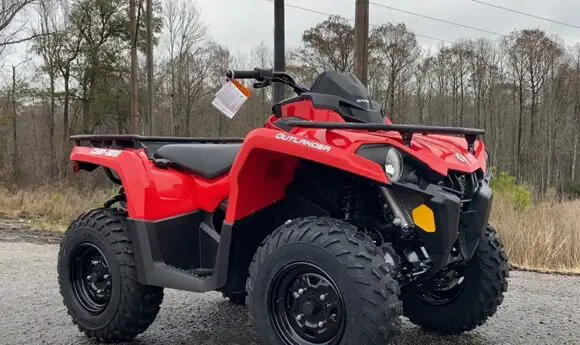
The Can-Am Outlander 450 is one of the more dependable light ATVs you can buy, and that comes down to a simple formula: a 38 hp Rotax 427 cc single-cylinder engine with electronic fuel injection and a CVT that keeps the power where you need it, plus a selectable 2WD/4WD drivetrain with the Visco-Lok auto-locking front differential. It’s not perfect, though.
Spend any time on the Can-Am owner forums and you’ll see the same four complaints again and again: stators that burn out (usually because the voltage regulator is overcharging), starter clutches that refuse to engage in cold weather on 2018-2019 units, power steering that drifts to the right until the SAS gets reset, and overheating that ends rides in limp mode. CVT belt wear in mud and loose rear sway bar bushings round out the list.
This article walks through each problem, what causes it, and the fixes that actually work.
Stator and voltage regulator failures
The charging system is the most common electrical failure on the Outlander 450, and it’s rarely the stator’s fault on its own. A 2007 Outlander 800 owner documented burning up stators three times in a row on Can-Am Forum, in a thread about the repeated failures.
Each one died on longer rides at higher RPM, and when he pulled them apart, the same phases were cooked every time. That’s the signature of a regulator dumping too much voltage into the windings, not a bad batch of stator parts.
Other owners see the warning signs at the gauge first. On a 2005 Outlander, the speedometer actually flashed “FAIL” before the machine started eating electrical parts. That owner measured charging voltage climbing toward 17 volts with the bad regulator still in place. A replacement regulator brought it back down to a steady 14.1 volts and the machine has been fine since.
The fix when your 450 keeps killing stators: replace the voltage regulator at the same time as the stator, and inspect every wire and connector between them. Melted insulation or corroded pins are usually what started the whole cycle. One owner who made all three changes at once, a new stator, a new regulator, and fresh wiring, finally stopped the pattern.
On older machines some riders convert the dry-mounted stator to oil cooling with a drilled-case mod, but that’s a bigger job than most people need.
One quirk to know: the stock charging system doesn’t reach its rated output until about 4,000-4,400 rpm. Warm idle voltage can sit around 12.6 volts, which is normal, not a fault, so don’t go replacing parts over it. If you run lights and accessories while puttering around slowly, you’ll drain the battery no matter what, which is why a healthy regulator matters even more on a working 450.
Newer machines are not immune either. A 2015 Outlander Max 500 XT owner reported a stator that quit at just 140 miles along with flywheel damage, so it’s worth testing charging voltage on any used 450 before you hand over money.
Cold-start starter clutch spring on 2018-2019 units
If your 2018 or 2019 Outlander 450 spins the starter but won’t fire in cold weather, you’re looking at the starter clutch, specifically the bendix spring. Owners describe it as the starter freewheeling: you hear the whir but the engine doesn’t turn, so you click the button ten or fifteen times before it finally catches.
Riders in northern states and Canada are the ones who hit this most, because the problem only shows up when the machine and the starter gear are cold. If your bike lives in a heated shop, you may never see it.
The 2017 models had this problem badly enough that dealers knew it by name. Can-Am claimed the 2018s were fixed, but a Minnesota owner who bought a new 2018 in October got stranded on an ice-fishing trip in December when the machine refused to start below about 32 degrees F.
His dealer replaced the spring behind the bendix with a lighter-duty unit so it takes less effort to engage the starter against the flywheel, as he detailed in the forum thread. The part on his invoice was 420238311, listed as spring, starter clutch.
Out of warranty, the spring itself is cheap and the job is doable in a weekend with the right puller. In warranty, push the dealer to swap it before winter, because this one tends to resurface whenever the temperature drops.
A 2016 owner had a rougher path: the dealer swapped the multifunction switch and the ignition switch with no luck, then the starter and starter drive before it was sorted, and the shop had another 450 in at the same time with the same symptom.
DPS drift to the right and the SAS reset
Outlander 450s with Tri-Mode Dynamic Power Steering are great until the steering decides it knows better than you do. The classic complaint: the machine pulls to the right, and even with the front wheels off the ground, they slowly crank themselves to the right on their own. You can check air pressure and tie rods all day and find nothing wrong, because the problem lives in the steering electronics.
What is happening is the steering angle sensor, the SAS, has lost its zero point, so the DPS motor fights to steer the machine even when you want to go straight. The fix is a dealer reset with the BUDS diagnostic tool. There is no home adjustment that does it properly, and owners who tried got nowhere until the shop re-zeroed the sensor.
Before you book that appointment, do the cheap checks first: tire pressure and tie rod ends, then a wheel alignment. If all of that is good and the wheels still drift in the air, it’s the SAS. Ask the dealer to verify the DPS firmware is current while they’re in there, since Can-Am has changed steering behavior in software over the years.
Radiator air pockets and overheating
The 450’s liquid-cooled Rotax runs warm in normal use, so when owners report limp mode after 30 minutes of riding, something specific is usually wrong rather than the engine being weak. The most common cause is an air pocket in the cooling system, often from day one. Dealers doing setup frequently top up the overflow tank and never check the actual radiator level, and a partially empty radiator will overheat exactly like a failed pump.
A Florida owner with a 2007 Outlander 500 had the shop replace the heat sensor, then rework the radiator shroud, and it still overheated and dropped into limp mode. The thread turned up the usual suspects, starting with the radiator itself: check the level there rather than just the overflow bottle. Then bleed the system from the bleeders on top of each cylinder head and confirm the thermostat actually opens.
On that generation, a BUDS update (bulletin 2007-08) also changed the fan control logic, and owners reported the fan ran more often and the machines stopped overheating afterward.
Practical checks for a hot-running 450: with the engine cold, pull the radiator cap and confirm coolant is right to the top. Bleed air from the head bleeders after any coolant service. Make sure the fan kicks on when the gauge climbs, and clean the radiator face, because mud and debris between the fins will defeat any cooling system.
The 450’s fan and shroud are small for the class, so anything that blocks airflow, from a winch fairlead to packed mud, shows up fast on the temperature gauge. Winches and accessories mounted in front of the radiator deserve a look too, since a missing or mis-routed shroud redirects airflow away from the core.
CVT belt wear in mud and aftermarket belt mix-ups
The CVT is the 450’s best feature on the trail and its weak point in the mud. Belt life collapses when the belt gets wet and gritty, and owners who regularly play in deep mud budget for belts the way other riders budget for tires. Squeal on takeoff and sluggish engagement are the early warnings.
There is a second trap that is purely aftermarket. A 2022 Outlander 450 owner bought a heavily advertised “world’s most badass belt” for $170 and found it sat a quarter inch proud of the secondary clutch. A short test roll had plastic shavings blowing out of the CVT snorkel as the oversized belt chewed the cover.
Forum members identified the problem in the belt thread: that belt number, WBB302, is correct for the Outlander 570 and some of the twins, but not the 450. The right family for the 450 is the 024 series, cross-referenced to OEM numbers 71590024 and 420280280.
The same belt family carries into the Can-Am Defender HD5, where owners see matching wear in utility duty. If you are looking at the bigger machine too, the Outlander 570 has its own list of documented problems.
The lesson: verify fitment against the OEM number for your exact model before buying an aftermarket belt. When you run a belt hard in mud, pull the cover and clean the clutch faces, then check for glazing before you park it for the season. A cheap belt job is a lot easier than a smoked clutch.
Clunks from the rear: sway bar bushings
If your Outlander develops a loud metal clunk from the back end when your weight shifts or the trail rocks the machine side to side, check the rear sway bar before you suspect the driveline. A 2012 Outlander 1000 XT owner chasing this noise heard it over every bump, even with the engine off while rocking the bike on its floorboards.
The cause turned out to be the sway bar bushing carriers: the bracket bolts work loose and the bushings wear, and the bar starts banging against the frame.
Have a friend rock the machine side to side and watch where the sway bar mounts to the frame. Tighten the four bracket bolts and re-check the movement. If the bushings are worn, they are cheap to replace. The BRP part is 706 001 098, sold as a cushion, and you need two.
Owners describe it as a 30 dollar fix you can do in the driveway, and it has been reported on machines with only a few hundred miles, so don’t assume a low-mileage 450 cannot have it.
cvt belt
The exact part owners reach for to fix this. Check the current price.
What to check before buying a used Outlander 450
Most 450s are honest machines with simple issues, so a used one can be a good buy if you run a few tests before handing over cash. The charging system is the first thing to check, because it is the most expensive failure on this bike. With a multimeter on the battery, note the voltage at idle and again above 4,000 rpm. You want roughly 12.6 volts at warm idle and 14.4 volts when you rev it.
Anything north of 15 volts points at a regulator that will fry a stator, and a battery that reads low at RPM points at a stator that is already weak.
On 2018 and 2019 models, ask whether the starter clutch spring has been updated to 420238311. If the seller shrugs, arrange a test start on a cold morning. Check the steering for drift on a straight flat road and at a standstill, since SAS resets are dealer work. Ask about overheating history and let it idle in the driveway long enough for the fan to cycle.
Look inside the CVT cover if you can, since belt condition tells you how the machine was ridden, and rock the rear end for sway bar clunks.
If you are cross-shopping in this class, the Yamaha Grizzly 700 is a proven competitor with its own set of known issues, and a Polaris Predator 500 is a different animal entirely, a lighter sport quad from another era.
With the 450’s numbers, a 5.4-gallon fuel tank and 678 pounds dry, plus a 1,300-pound towing rating, a clean example with a sorted charging system will give you years of work and trail time. If you can’t arrange a cold start, a dealer inspection that includes a charging test and a compression check is worth the money on any used machine.
Maintenance that keeps a 450 out of the shop
Most of the problems above are preventable with a seasonal routine. Test charging voltage at the battery every spring, and clean and dielectric-grease the connectors between the stator, regulator, and battery, because corrosion is what turns a small electrical fault into a burned stator. Flush and bleed the cooling system per the manual, and blow out the radiator fins after every ride in mud or fields.
Keep the battery on a tender when the machine sits, since a deeply discharged battery makes the regulator work harder than it should.
The CVT deserves attention after any water crossing or mud run: open the cover and wipe down the clutches, then inspect the belt for glazing or fraying. Keep the rear sway bar bolts on the same check schedule as your grease fittings. If you buy a used 450, do all of this in the first month, and you’ll be ahead of most owners.
If the 450 turns out to be too small for your jobs, the CFMoto Uforce 1000 delivers a lot more machine for similar money, with its own quirks to learn.
Bottom line: the Outlander 450 is a capable, honest ATV whose problems are well documented and mostly cheap to fix. The charging system deserves respect, and 2018-2019 cold-start machines may need the updated bendix spring. DPS drift is a dealer reset. None of it is a dealbreaker if you know what to look for. Check the voltage and test it cold, and treat the belt and cooling system right, and the 450 will keep running for a long time.
If you’re ordering supplies, CVT belt and battery maintainer are the items owners reach for first when they start working on these machines.

