
As an Amazon Associate I earn from qualifying purchases. This article contains affiliate links that may earn a commission at no extra cost to you.
The Bombardier Traxter 500 is the oddball utility quad from the late 1990s, and the two complaints you hear from owners more than anything else are electric shift issues and backfiring. The push-button gearbox is clever when it works and frustrating when it does not, and the carbureted single likes to pop on deceleration as it ages.
This article covers the problems owners actually report in the forums, what causes them, what they cost to fix, and what to check before buying a used one.

For context, the Traxter 500 uses a 498cc single-cylinder four-stroke engine with a rear-mounted radiator, a five-speed push-button hydraulic gearbox with no clutch lever, and a speed-sensing front differential that locks fully. It is the same machine Bombardier built in partnership with John Deere, which sold a green and yellow version for farm use. That driveline is where the character, and most of the trouble, lives.
The Push-Button Shifter Is the Traxter’s Weak Spot
The push-button shifter is the Traxter’s weak spot. There is no shift lever and no clutch lever. A rocker button runs a hydraulic auto-clutch through five speeds, with High and Extra Low ranges plus Neutral, Reverse, and Park. Bombardier put the whole shift brain on a control module with gear indicator lights. It was ahead of its time, and it is also the most reported failure area on the whole machine.
Owners described sticky shifting and skipped gears from the launch years. One owner in the classic “good, bad, ugly” thread on ATVConnection summed it up as “my problems are backfire and the shifting gear, like many other people as far as I know.” Another veteran in the 2001 XT thread put it as “ride quality and once in a while you’ll see electro-shift problems.”
The scary failures show up as a machine stuck in one gear with all the shift lights flashing, which happened to a 2000 model owner who detailed the whole saga in the gear lights thread. After a stator had already taken out his flywheel, the quad locked in first. It turned out the internal shift linkage was bent, so the forks could not center. Replacing that linkage put it back to shifting, which shows how mechanical the root cause usually is.
Diagnose in order: check battery voltage first, because every electronic part misbehaves on a low battery. Then inspect the shift motor connector under the seat. If the system shifts but the lights are wrong, suspect the position sensor. If it will not shift at all and the lights look normal, the problem is usually mechanical inside the transmission case, not electrical.
Backfiring, Rough Idle, and Fuel Issues
Backfire complaints show up on the model’s very first forum threads from 2000, which tells you it was there from day one. The pop is usually exhaust backfire on deceleration, caused by lean mixture, an exhaust leak at the header joint, or retarded spark. It gets worse as the carburetor leans out with age and the packing in the exhaust breaks down.
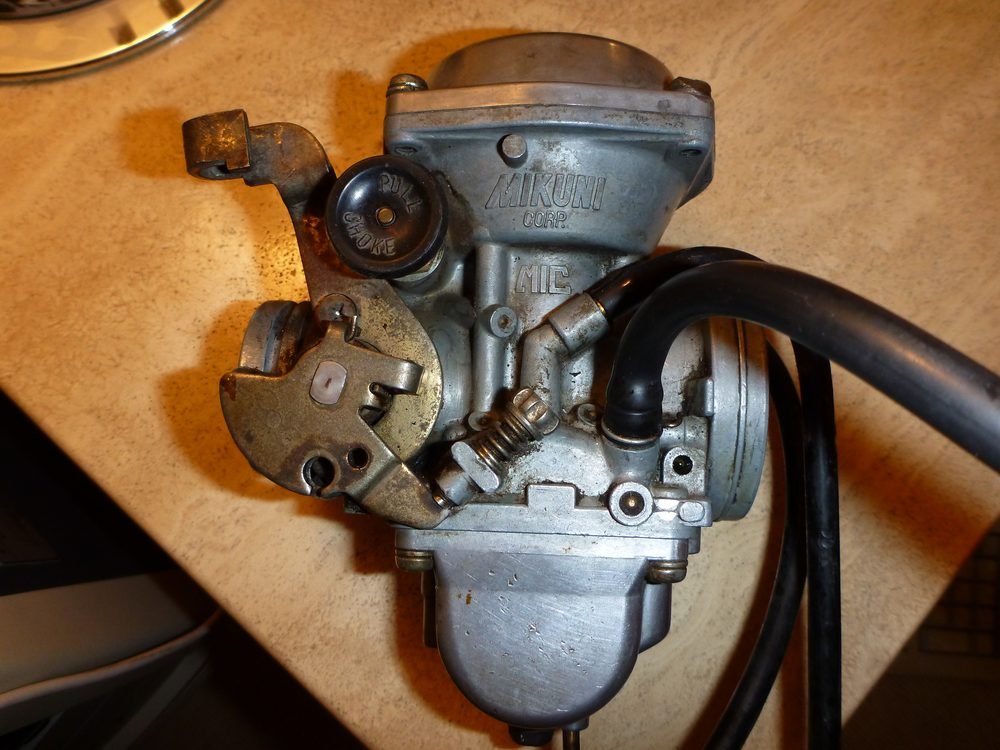
The carburetor problems are well documented on the 2003 Traxter XL carb issue thread. That owner had hard starts, fuel pushing out of the carb vent tube, and finally found debris from a deteriorated rubber fuel line inside the carb. The carb is a Mikuni OEM assembly, and the catch is that replacement parts now cost close to the value of the whole machine, which is why a good clean and new soft lines matter.
On a carbureted quad, this one job cures more running complaints than any other repair. Drop the bowl, blow out every jet with compressed air, replace the intake hose, the fuel filter, and the carb base gasket, and fit an inline filter. If it has been sitting for a season, expect stale fuel varnish in the jets and a sticky needle.
Use a quality carb cleaner and let the small passageways soak before you blow them through, because the pilot jet is the first to plug and it is the one that controls the idle.
Charging System and Stator Failures
The electrical system is the second most common grief point, and one owner’s story is the cautionary tale. On his 2000 machine the stator bolt backed out, the stator got chewed up by the flywheel, and it took out both the charging and the spark. After that got fixed, a separate issue stuck the quad in first gear, so a running repair turned into a bench diagnosis.
Stator and flywheel failures on 2001-era machines are real but not common, and they usually start with a loose mounting bolt or a worn flywheel key.
When charging trouble shows up on a Traxter, work the diagnosis before you open the side cover. Measure regulator output at the battery at idle and at 3,000 rpm, clean every ground, and inspect the wiring harness where it rubs the frame. A battery that does not charge after a season of sitting is often a tired regulator or a dirty connector, not a burned stator. Only pull the stator when the charging output and the resistance checks point at it.
The same overcharging or undercharging grudge is why you should keep a voltmeter handy on any 20-year-old machine. A weak battery also fakes out the shift system, so sorting the charging and battery first is the cheapest way to clear a whole cluster of intermittent electrical faults.
One Oil for Engine and Transmission
The Traxter shares a single sump between the engine, the transmission, and the hydraulic auto-clutch. There is no separate gear oil, and the correct grade matters more than on almost any other quad because that same oil has to satisfy the engine bearings and the clutch.
One veteran owner in the 2001 XT thread was blunt about it: “the same oil that lubricates the engine also acts as a transmission fluid, so you can’t just dump 5w-30 in it and expect good results.” You need a 4-stroke ATV oil with the right friction modifiers. Skip that and you get scratchy shifts and clutch slip, which then gets blamed on the shift system.
Use a proper 4-stroke ATV oil made for a wet clutch and change it on schedule. It is the single cheapest thing you can do to keep the gearbox alive.
The Rear Radiator Is a Dirt Magnet
Bombardier mounted the radiator behind the seat, low in the machine, to keep hot coolant away from the rider. On a utility quad that works in mud, that location is a liability. It sits exactly where mud, grass, and debris collect, and owners who push their machines in the slop ask one question over and over: how hard is it to clean the radiator once it is full of mud?
When mud packs the fins, the liquid-cooled single loses airflow and the temperature climbs. Owners report overheating on machines that sit low and work hard. Blow out the radiator fins after every muddy ride and keep the fan and the fan switch clean. Overheating a 498cc liquid-cooled single is how you get a warped head and a blown head gasket, neither of which is a cheap fix on a 20-plus-year-old machine.
Ride Quality and the Heavy Utility Chassis
No honest review of the Traxter 500 skips the ride. It is a heavy machine at about 715 pounds dry, and the suspension travel is short by modern standards. Owners describe a firm, truck-like feel rather than a cushy trail ride, and a couple of long-term owners call the ride quality a proper complaint on the list. On rough ground it pounds through the seat and the steering, which you feel on a long ride.
That weight also shortens tire life and makes the quad feel lazy on hard-pack compared to a sportier model. The upside is the rubber-duck build quality: owners who maintain them report excellent reliability, a big reason the model still has a devoted following. If you are buying one to work hard, the stiff ride and the heavy chassis are the trade for the towing and pulling ability.
Cheap wins here are fresh tires and a bit more air pressure for hard-pack work, plus greasing the suspension pivots so the bushings do not bind and add harshness. Do not chase the ride with suspension mods on a 25-year-old machine; the money is better spent on the driveline.
The John Deere Connection
Part of the Traxter’s story is a factory tie-up. Bombardier and John Deere shared the platform for a while, and Deere sold a green and yellow version of this same machine for farm and acreage use. Owners in the forums note the farm version carries Deere decals over the same Traxter bones.
If you see one of those green utility quads at an auction, it is the same driveline and the same shift system, which means the buying advice here applies to it too.
That shared pedigree also explains why the Traxter’s true AWD is so well regarded. The speed-sensing front differential locks both front wheels together under traction loss, a design described as “true all-wheel drive,” and owners who ran the machine in mud and snow praised it as the best thing about the quad. It is a capable work machine when the shift system cooperates.
atv engine oil
A practical fix that most owners swear by. See today’s Amazon price.
What to Check Before Buying a Used Traxter 500
Buying a 25-year-old utility quad you cannot ride hard is a gamble, so work through the known weak spots in person before you hand over cash.
- The shift system. Ride it and run every position: all five gears, High, Low, Neutral, Reverse, and Park. Any flare, refusal, or grinding is a red flag, because this is the known weak system.
- Gear indicator lights. A flashing display or a gear number that will not settle points to a shift sensor or wiring fault, not always a cheap fix.
- Backfire and stumbles. A little backfire on deceleration is a tune-up item. A lot, or a hard start, points to a lean carb or an exhaust leak.
- Carb and fuel hoses. Ask when the carb was last cleaned and whether the fuel hoses were ever replaced. Old hose debris is the classic cause of both hard starts and the gas smell around the intake.
- Cooling system. Make sure the fan cuts in when the machine warms up. Head gasket and warped-head repairs exceed the value of the quad.
- Oil history. Ask whether the owner used a correct 4-stroke ATV oil, because automotive oil ruins the shift feel.
Bring a fresh battery or a battery maintainer for the test. A weak battery makes every sensor fault light on the Traxter come alive and can fool the shift system.
On the ground, treat these as the fast passes before money changes hands: a shift exercise in every position, a warm-engine deceleration test for backfire, a look at the fuel lines for softness, and a fan test at operating temperature. The gearbox is the known weak system, so if the shift does not feel crisp at every detent, walk away or price in the repair.
Maintenance That Cures Most Traxter Complaints
Most Traxter owners agree the machine is reliable when it is fed the right fluids and kept out of long storage. The problems that show up are almost all old-machine problems: stale fuel, dried oil, packed radiators, and tired shift connectors.
- Use only a 4-stroke motorcycle ATV oil with the wet-clutch package, changed on schedule.
- Keep the fuel system new: replace soft hoses, fit an inline filter, and run a stabilizer if it will sit.
- Blow out the rear radiator after every muddy ride and confirm the fan works.
- Grease the suspension pivots and driveshaft carrier, and look for worn boots.
- Watch the temperature gauge on long pulls and let a 25-year-old quad cool down before you shut it off.
Want the full picture before you buy? Our Bombardier Traxter 500 specs and top speed guide goes through the verified numbers. The Bombardier Quest 650 has its own list of recurring issues if you are comparing BRP utility quads from the same era, and the Can-Am Outlander 450 problems show what replaced the Traxter in the line. For a modern contrast, the Yamaha Grizzly 700 problems cover a very different take on the utility class.
Photos: the featured image is a Bombardier Traxter mudding, and the in-post Mikuni carb image is CC BY-SA 3.0 (Wikimedia Commons author Wusel007).
Bottom line. The Bombardier Traxter 500 was a clever machine with real utility, and its Achilles heel is the push-button electro-shift system more than anything else. Owner-verified complaints center on sticky shifting, electro-shift errors, and carburetor and backfire issues as the quad ages. All of them are fixable when you expect them, and most of the full cost traps come from neglected cooling and the wrong oil.
Buy one with a good shift test behind it, treat the rear radiator and the shared sump as high-maintenance items, and you get a capable, quirky machine that owners who did it right swear is as reliable as anything from the era.

