
As an Amazon Associate I earn from qualifying purchases. This article contains affiliate links that may earn a commission at no extra cost to you.
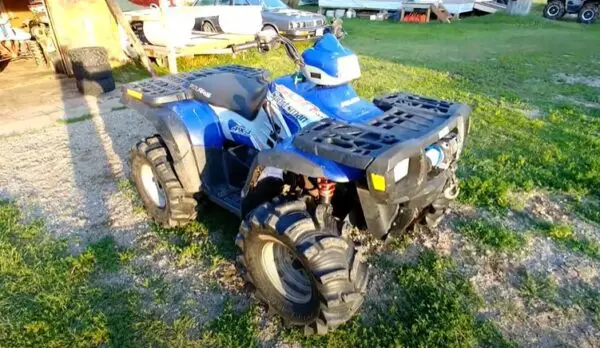
The Polaris Sportsman 600 twin is the quad Polaris sold in the early 2000s for riders who wanted more muscle than the 500 single but did not want to jump to a 700. It runs a liquid-cooled, carbureted twin with shaft drive front and rear, riding the same PVT clutch-and-belt transmission used across the Sportsman line. The machine is capable in the woods, but it is old enough now that the common problems are well documented by owners. The failures you will actually see are cracked primary clutch sheaves, head gaskets that give out after overheating, plus intake boot air leaks. Overcharging voltage regulators and an AWD system that stops engaging round out the list. This article walks through each one, what causes it, what it costs to fix, plus what to check before you buy a used 600 twin.
Primary Clutch Sheaves Crack Where the One-Way Bearing Rides
The most expensive common failure on the 600 twin is the drive (primary) clutch. One owner who documented a 2004 Sportsman 600 primary clutch rebuild found the rear sheave cracked and grooved where the one-way bearing rides, and the front sheave cracked and scored badly enough that rebuilding was a lost cause. The one-way bearing wears the aluminum sheave faces over time, and once the grooves are deep the clutch slips and squeals under load. A glazed belt sounds different: a high-pitched squeal on hard throttle that fades when you ease off. Belts are cheap and take about twenty minutes to swap once the cover is off, so do not confuse a tired belt with a dead clutch.
The fix for a worn clutch is a replacement drive clutch. The good news is the 600 uses the same clutch family as the 1998-era Sportsman 500, along with the Magnum and Big Boss 500 machines, so a Sportsman 500 primary is a direct fit and much easier to find than a 600-specific part. Owners have also run aftermarket Comet and Parts Ace clutches with decent results, mostly on machines used for light utility work and plowing. When you have the cover off, inspect both sheaves and the one-way bearing before you spend money. If the bearing is bad, the machine may not want to start in gear or will try to creep when it does start.
High Gear Grind and Shift Linkage Slop
Another thread that keeps coming up is the high gear grind. The owner of a 2004 Sportsman 600 reported that shifting into high from a stop just ground until he dropped back to low, and no amount of finesse helped. The trick that isolates the cause is shutting the engine off and trying the shift. If it goes into gear with the motor off, the problem is usually the shift linkage, the bell crank, or the park lockout mechanism on the side of the transmission rather than the gears themselves.
Never force a shift on the 600 twin. Owners who hit the grind shut the machine off, put it in gear, then restart in gear, which works even on machines with some wear. From there the checklist is linkage adjustment, then the bell crank, then the park lockout, before you pull the transmission cover. A bad one-way bearing in the drive clutch shows up the same way, so check the clutch first if the machine also creeps or does not want to start in gear.
Overheating That Ends in a Head Gasket Job
Overheating is one of the more serious issues on the 600 twin, and the classic end point is a blown head gasket. One owner with a 2003 Sportsman 600 that lacked power and ran hot solved the overheating by replacing the head gasket, then found the engine still would not pull past 35 mph. After the gasket job his compression read 160 psi in one cylinder and 180 psi in the other, which is on the high side and a red flag if you see it on a used machine.
Keep an eye on the cooling fan and the thermal switch in the radiator. On the 600 the fan defaults to always-on when the circuit fails, so a fan that runs constantly even with the key off points at a fuse or the inline circuit breaker rather than the fan motor. If the fan never runs, the thermal switch in the radiator is the usual suspect. Either way, fix the cooling issue before you ride hard; the head gasket is the part that pays for the delay.
Carburetor and Intake Boot Air Leaks
The 600 twin is carbureted, and the carb has one notorious weak point: the rubber intake boot between the carb and the head. Owners report the twin losing power and backfiring a few minutes into a ride once the engine warms up, and the cause is often a hairline crack in that boot that opens up when it gets hot and sucks air. One owner fixed an identical issue on a 700 twin by replacing the cracked manifold, which was nearly invisible when cold. A quick test is to stick duct tape over the bottom of the boot; if it runs better, the boot is cracked.
If the boot is fine, clean the carb. A plugged pilot jet causes the same cut-out-and-backfire behavior, and the carb comes off easily once the side panels and seat are out. Owners confirm the 600 runs a Mikuni 34 with a factory 155 main jet, and the main jet washer carries part number 3130014 if you lose it during a rebuild. If the engine idles fine but stumbles under load, that is the classic plugged-pilot-jet signature. A full carb clean usually cures it. Check the vacuum slide diaphragm for tears while you are in there, and never seal a leaking manifold with silicone; that is a band-aid that causes a lean condition and backfiring.
Charging System: Regulators That Overcharge, Stators That Quit
The charging system is the 600 twin’s most common electrical complaint. One owner watching a failing regulator on his 2004 Sportsman 600 saw the battery symbol light up on the speedo and voltage climb to 20 volts when he revved the engine, which cooks the battery and every bulb behind it. The stock regulator is part 4011053 with seven wires, and the 3-phase stator feeds it. Owners have swapped in aftermarket Mosfet regulators with good results, and charging settles around 14.5 volts after the fix.
Test the system before you replace anything. At idle the battery should see about 13 volts, and no more than 15 volts at top rpm. A battery light that flashes on and off while riding is often a broken wire at the regulator rather than a dead stator; one owner paid a dealer to chase exactly that and the fix was a single wire. Dealers will happily quote $300 for a stator, so test the regulator first. If the machine goes completely dead with no gauges at all, check the battery cables and the multi-pin white connector under the front cover. Keep in mind that the Ducati ignition used on early 600 and 700 twins is known to fail randomly.
Reverse Limiter Cutting Power When You Need It
The reverse limiter is a Polaris safety feature, not a breakdown, but it catches new owners off guard. On the 4WD Sportsman models, selecting reverse limits engine power and cuts the front drive until you press the override button. Owners describe the machine dying when shifted into reverse unless the button is held, which is the limiter doing its job. If the reverse limiter stops working entirely, the problem is usually the left control switch, part 4011835, which also runs the high-low range and other functions; it costs around $78 from a parts house.
If the dash dies all at once (speedo, tach, reverse limiter), check the connectors before buying parts. One owner lost everything on the dash at the same time and it turned out to be a loose plug on the left control switch; reseating it restored every function. The wiring and connectors on that switch are a known trouble spot on the 600 twin.
AWD That Stops Engaging (or a Light That Never Goes Out)
The on-demand AWD system on the 600 twin engages the front drive through a transfer case, and owners report two flavors of failure. The first is AWD that never engages, with the AWD light staying on regardless of the switch position. One owner tested his early 2004 machine and found 12 volts at the transfer case with the switch on and 0 volts with it off. He then swapped speedos with a friend to rule out the gauge, and the front drive still would not lock in. That points at the engagement mechanism in the transfer case or the front differential rather than the switch.
The second flavor is AWD that engages but stays locked, which usually comes back to the same transfer case hardware sticking. Before you tear into the case, verify the switch, the wiring to the transfer case, plus the speedo connections, since a bad speedo connection can leave the AWD light stuck on without any mechanical fault. Engagement trouble on these machines typically traces to the actuator or shift fork inside the case, and both are serviceable without replacing the whole unit.
CV Boots and Tires: The Small Stuff That Adds Up
Beyond the big-ticket items, the 600 twin has a handful of small problems that add up on a used machine. CV boots are the most common: an owner who bought a 2004 600 with 500 km on the clock found two split boots from age alone, because the rubber had sat for years. Inspect every boot on the shafts before you buy, and plan on replacing them if the machine has been parked.
Wheel and tire combos matter on this quad. The 600 was not offered with aluminum wheels, so if you plan to run aftermarket wheels or 26-inch tires you will likely need longer wheel studs or spacers to clear; owners report 26-inch tires rubbing without them. The good news is parts are cheap and the platform shares a lot with the 500 and 700 twins, so almost everything is available.
What to Check Before Buying a Used Sportsman 600
If you are looking at a used Sportsman 600, the clutch and the charging system are the two things that decide whether the quad is a deal or a project. Pull the clutch cover and look at the sheaves; if the one-way bearing has grooved them, budget for a new primary clutch. Test the charging system with a multimeter at the battery: 13 volts at idle and no more than 15 at top rpm is healthy, and anything near 20 volts means the regulator is going to cook the battery. Bring a multimeter and a flashlight; you can do both checks in the seller’s driveway in five minutes.
Ask when the head gasket was done and whether the machine has ever overheated, since that is the one failure that totals the engine if ignored. Look at the CV boots and check the intake boot for cracks. Then confirm the AWD light goes out and the front drive locks in when you flip the switch. The 600 twin is a strong and simple quad when it is healthy, and it shares parts with the rest of the early-2000s Sportsman family, which keeps repairs affordable. For context on how Polaris reliability plays out across model lines, the Polaris Ranger years to avoid breakdown covers the utility side of the family. The Polaris Predator 500 problems post covers the same era of twin reliability from the sport side.
Maintenance That Keeps the 600 Twin Alive
Most of the 600 twin’s failures are age and neglect problems rather than design flaws, and a simple schedule keeps them away. Change the engine oil and the gearcase and differential fluids on schedule; an owner who bought a low-mile 2004 600 replaced all of them including the diffs before riding. Clean the carb and inspect the intake boot every season, and replace the air filter before it gets caked.
Give the clutches a look once a year. Pull the cover to check the belt for glazing and watch the one-way bearing for wear, especially if the machine creeps in gear or squeals on takeoff. Replace the drive belt every couple of seasons or when you see cracks on the inside of the belt; it is a twenty-minute job that prevents a trailside tow. Keep the cooling system honest: verify the fan cycles and the thermal switch works before the hottest part of the season. On the electrical side, a yearly voltage check at the battery catches a failing regulator before it takes out the battery and bulbs. None of this is exotic, and all of it is doable in a home garage with basic tools.
Bottom line: the Polaris Sportsman 600 twin is a capable early-2000s utility quad with a documented set of age-related problems. The primary clutch, the charging system, and the intake boot are the failures that actually show up in owner threads, and every one of them is fixable with parts that are still cheap and available. Go in knowing what to look for and do the checks above before you hand over cash. The 600 twin will give you years of trail and work use. If you are also weighing newer alternatives, the Can-Am Outlander 450 problems post covers a popular option from another brand.
If you’re ordering supplies, CVT belt and synthetic ATV oil are the items owners reach for first when they start working on these machines.

